
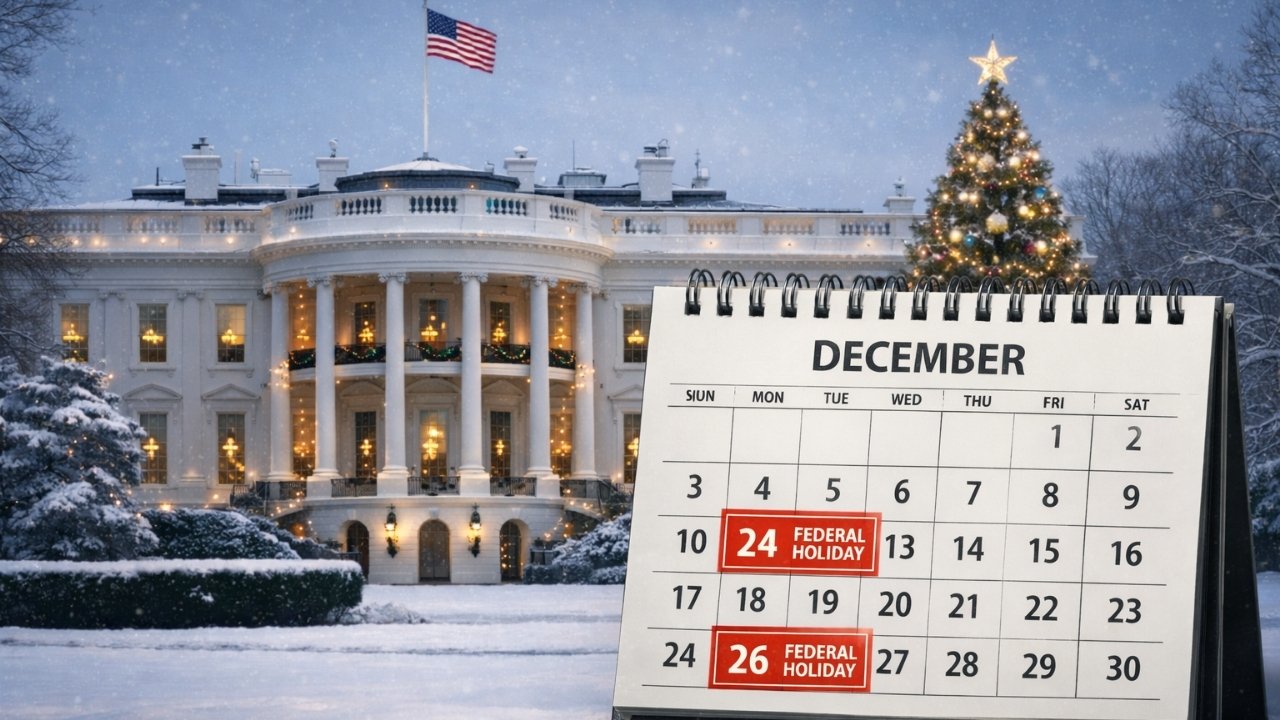
President Donald Trump has officially declared Christmas Eve, December 24, and the day after Christmas, December 26, as federal holidays for the year 2025. The announcement was made through a formal presidential proclamation issued by the White House in mid-December.
This decision applies to executive departments and agencies across the federal government. With Christmas Day already recognized as a federal holiday, the order effectively creates an extended Christmas break for most federal employees.

The move comes at a time when holiday schedules were already under close attention due to calendar alignment in 2025. Christmas Day falls on a Thursday, making adjacent days significant for work scheduling across government offices.
Table of Contents
Official White House Proclamation Explained
The White House proclamation directs the closure of executive departments and agencies on December 24 and December 26, 2025. These days are treated as excused days off for federal employees, following standard federal pay and leave rules.
Under the order, employees who are normally scheduled to work on those days will not be required to report for duty. Pay and benefits will continue as if the employees were working a regular day.

The proclamation clearly states that agency heads may still require employees to work if their duties involve national security, defense, public safety, or other critical government functions.
BREAKING: President Trump signs executive order making Christmas Eve and December 26th OFFICIAL federal holidays:
“By the authority vested in me as President by the Constitution and the laws of the United States of America, it is hereby ordered:
All executive departments and… pic.twitter.com/UavlTxcFvT
— Benny Johnson (@bennyjohnson) December 18, 2025
How the 2025 Christmas Schedule Changes for Federal Workers
With the addition of Christmas Eve and December 26, most federal employees will receive a longer, uninterrupted break around the holiday period. Since December 24 falls on a Wednesday and December 26 on a Friday, the schedule creates a natural extension around Christmas Day.

For many workers, this means being off from Wednesday through Sunday, depending on their agency and role. This structure reduces mid-week work disruptions and simplifies holiday staffing needs.
Such scheduling adjustments are made through presidential authority and are separate from permanent federal holidays established by Congress.
Details of the Federal Holiday Announcement
- Christmas Eve (December 24, 2025) is declared a federal holiday
- December 26, 2025 declared a federal holiday
- Christmas Day (December 25) is already a federal holiday
- Applies only to executive branch federal agencies
- Essential and emergency personnel may still be required to work
This declaration applies only to the 2025 calendar year and does not amend the permanent federal holiday schedule.
Who Is Covered Under This Holiday Order
The order applies to employees working within executive departments and agencies of the federal government. This includes civilian federal workers across multiple departments.
However, the proclamation does not automatically extend to private-sector employees, state governments, or local governments. Each employer or jurisdiction retains the authority to set its own holiday schedule.
Federal contractors and private companies that work with government agencies are also not automatically included unless their contracts specify otherwise.
Is This a Permanent Change to Federal Holidays?
No permanent change has been made to the federal holiday calendar. Christmas Eve and December 26 are not being added as recurring federal holidays.
Federal holidays can only be permanently established through legislation passed by Congress. This proclamation is a one-year administrative action specific to 2025.
Similar temporary holiday closures have occurred in past years under different administrations when Christmas fell mid-week.
Historical Use of Presidential Authority for Holiday Closures
Presidents have previously used executive authority to grant federal employees additional time off around major holidays. These decisions are often based on calendar alignment and operational efficiency.
In past years, Christmas Eve has occasionally been declared an excused day when Christmas fell on a Tuesday or Thursday. The inclusion of December 26 is less common but not without precedent.
These actions are administrative in nature and do not require congressional approval when applied for a single year.
Impact on Government Operations and Public Services
Most federal offices will be closed on December 24 and December 26. This may affect services such as passport processing, Social Security office visits, and administrative appointments.
Online services and automated systems will continue to operate. Emergency and essential services, including law enforcement and national defense operations, will remain active.
Members of the public are advised to plan ahead for any government services that require in-person visits during that week.
What This Means for the Workforce
While the proclamation applies only to federal employees, it may influence holiday scheduling decisions in other sectors. Some private employers align their holiday policies with federal closures.
However, there is no legal requirement for private businesses to observe Christmas Eve or December 26 as paid holidays. Policies will vary depending on employer guidelines and local labor rules.
State and local governments may issue their own announcements regarding holiday closures closer to the end of the year.