
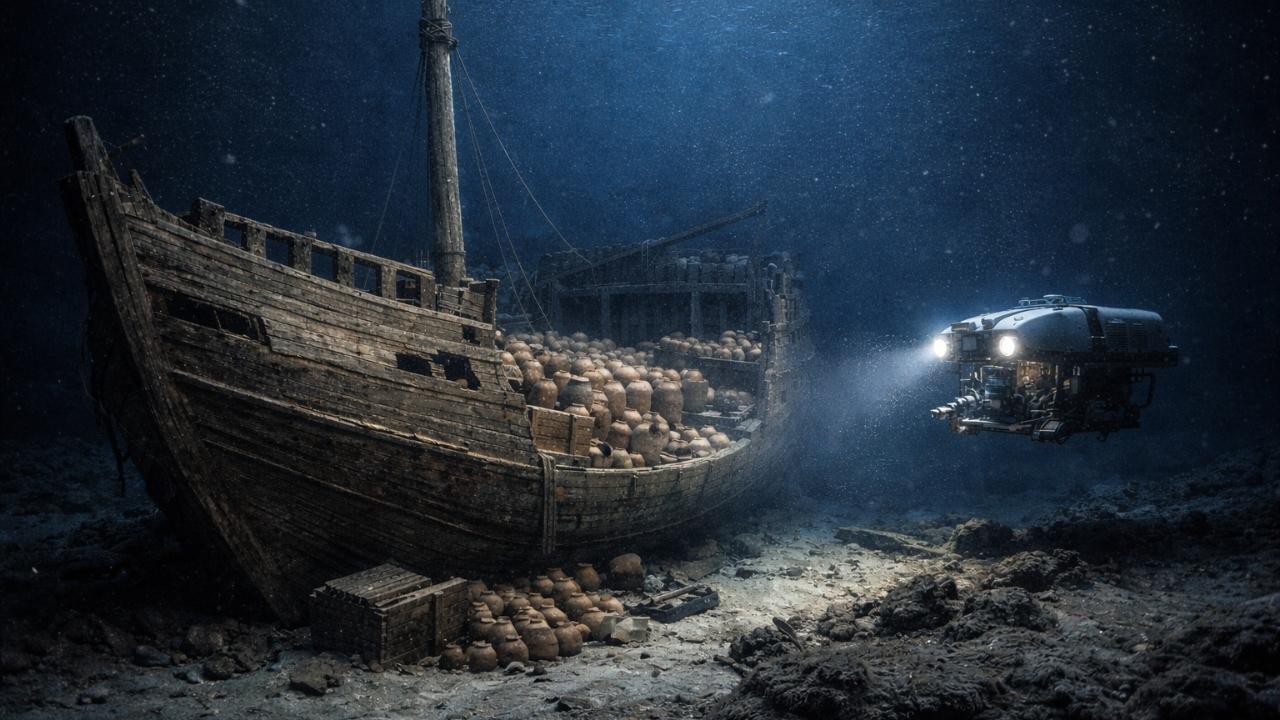
A standard French naval seabed patrol has unexpectedly uncovered one of the most significant underwater archaeological finds in recent decades. Resting more than 2,500 meters beneath the Mediterranean Sea, a remarkably intact 16th-century merchant ship has been identified, setting a new depth record for shipwreck discoveries within French territorial waters. The vessel has been provisionally named Camarat 4 and is already attracting global attention from maritime historians and archaeologists.
What sets this discovery apart is not only the depth at which the ship lies but also how well it has survived. For more than five centuries, the wreck has remained shielded by extreme pressure, cold temperatures, and complete darkness. These conditions have effectively preserved the ship as a near-frozen moment in history, offering researchers an evident glimpse into early modern Mediterranean trade.
Table of Contents
How a Routine Mission Led to a Rare Find

The discovery took place in March 2025 during routine seabed monitoring conducted by the French Navy off the coast of the Var region in southeastern France. Advanced sonar systems detected an unusually sharp, well-structured signal at depths far below those typically associated with archaeological sites.
Given the clarity of the sonar data, naval teams deployed remotely operated vehicles to conduct further investigation. High-definition video footage quickly confirmed the presence of a wooden shipwreck resting upright on the seabed. The visible hull structure and organized cargo immediately indicated that this was not a recent loss, but a historically significant vessel.
#CommuniquéDePresse | Découverte remarquable 🌊🏺⚓️
L’épave la plus profonde référencée dans les eaux sous juridiction française, au large de Ramatuelle (83) !
Retrouvez ➕ de détails ici 👉 https://t.co/pDG1Ys01UU pic.twitter.com/Waroqk2NSP
— Préfecture maritime de la Méditerranée (@Premarmed) June 12, 2025
Determining the Ship’s Age and Purpose

Maritime specialists analyzed the ship’s construction features, proportions, and exposed artifacts to establish its age. The evidence points clearly to the 16th century, placing the wreck at approximately 500 years old. This period was marked by intense commercial activity across the Mediterranean as European trade networks expanded rapidly.
The vessel is believed to have been a merchant ship rather than a military one. Its design emphasizes cargo capacity over armament, consistent with vessels used to transport goods between Southern Europe, North Africa, and parts of the Near East. The ship’s upright position and intact structure suggest a sudden sinking, possibly caused by severe weather or structural failure.
Where the Wreck Lies and What it Looks Like
Camarat 4 is located offshore between Saint-Tropez and Ramatuelle, in an area where the seabed drops sharply into deep marine basins. These dramatic underwater landscapes have rarely been explored due to the technical challenges involved, making the discovery even more notable.

Measurements obtained by ROVs indicate that the ship is approximately 30 meters long and 7 meters wide. Although some sections of the hull are partially buried in sediment, the vessel’s overall shape remains clearly visible. The cargo appears largely undisturbed, supporting the hypothesis that the ship sank rapidly and settled gently on the seabed.
Why the Ship is So Well Preserved
The extraordinary preservation of Camarat 4 is attributable almost entirely to its extreme depth. At more than 2.5 kilometers below the surface, the environment is hostile to most forms of biological life. Low oxygen levels, near-freezing temperatures, and weak currents dramatically slow the degradation of organic materials such as wood.
As a result, large portions of the hull planking and internal framework are still intact. Sediment has gradually settled around the ship, stabilizing the structure and protecting it from collapse. Unlike many shallower wrecks, there is no evidence of fishing damage, looting, or modern interference.
Cargo Clues to 16th-Century Trade
The ship’s cargo provides some of the most valuable insights into its journey. Surveys have revealed hundreds of ceramic jugs and plates arranged in neat stacks rather than scattered across the seabed. This orderly placement reflects deliberate stowage practices and strongly suggests the vessel sank rapidly.
Researchers have also identified iron bars, metal fittings, and heavy iron objects, including what may be a small cannon or defensive weapon. This combination of everyday trade goods and basic protection was typical for merchant ships navigating busy and sometimes dangerous trade routes during the 1500s.
A Careful, Non-Invasive Research Strategy
All research conducted to date has employed a strictly non-invasive approach. After the initial sonar detection, ROVs were used to collect high-resolution imagery, video footage, and environmental data without making physical contact with the wreck. No artifacts have been removed from the site.
Scientists are now using advanced photogrammetry to create detailed three-dimensional digital models of the ship. This enables in-depth analysis of the vessel’s structure, cargo arrangement, and condition while ensuring that the wreck remains preserved exactly where it lies.
Why Camarat 4 Matters to Maritime History
The 16th century marked a significant turning point in Mediterranean commerce, with growing maritime traffic and increasingly complex trade networks. Camarat 4 offers a rare opportunity to study a single merchant voyage exactly as it was at the moment it was lost.
Because the wreck lies far beyond depths affected by fishing, anchoring, or salvage operations, it retains contextual details that are often destroyed at shallower sites. Ship layout, cargo organization, and construction methods can all be studied in place, providing invaluable data on early modern shipbuilding and trade logistics.
Technical Limits and Preservation Decisions
Exploring a site at this depth presents significant technical challenges. Equipment must withstand extreme pressure, total darkness, and near-freezing temperatures. The ROVs used for this mission rely on reinforced frames, specialized lighting, and precise navigation systems to operate safely.
While artifact recovery is not entirely ruled out for the future, experts agree that any such effort would require complex lifting operations and years of conservation work. For now, preserving the ship on the seabed is considered the most responsible and scientifically sound option.
Protection Status and Future Research
French authorities have officially designated Camarat 4 as a protected underwater heritage site. Its exact location has not been publicly disclosed, and access is strictly controlled to prevent unauthorized activity.
Future research plans focus on expanding non-invasive surveys, refining digital reconstructions, and improving the analysis of limited environmental samples better to understand the ship’s sinking and long-term preservation. The aim is to build a comprehensive scientific record while leaving the wreck undisturbed.
Balancing Ethics, Science, and Public Interest
Experts involved in the project emphasize that deep-sea cultural heritage must be managed with care and restraint. Any future decision to recover artifacts would require clear scientific justification, sufficient conservation resources, and meaningful public benefit.
In the meantime, French authorities plan to share selected images, digital models, and research findings with the public. This approach supports education and transparency while ensuring that one of the Mediterranean’s most remarkable deep-sea discoveries remains protected for future generations.