
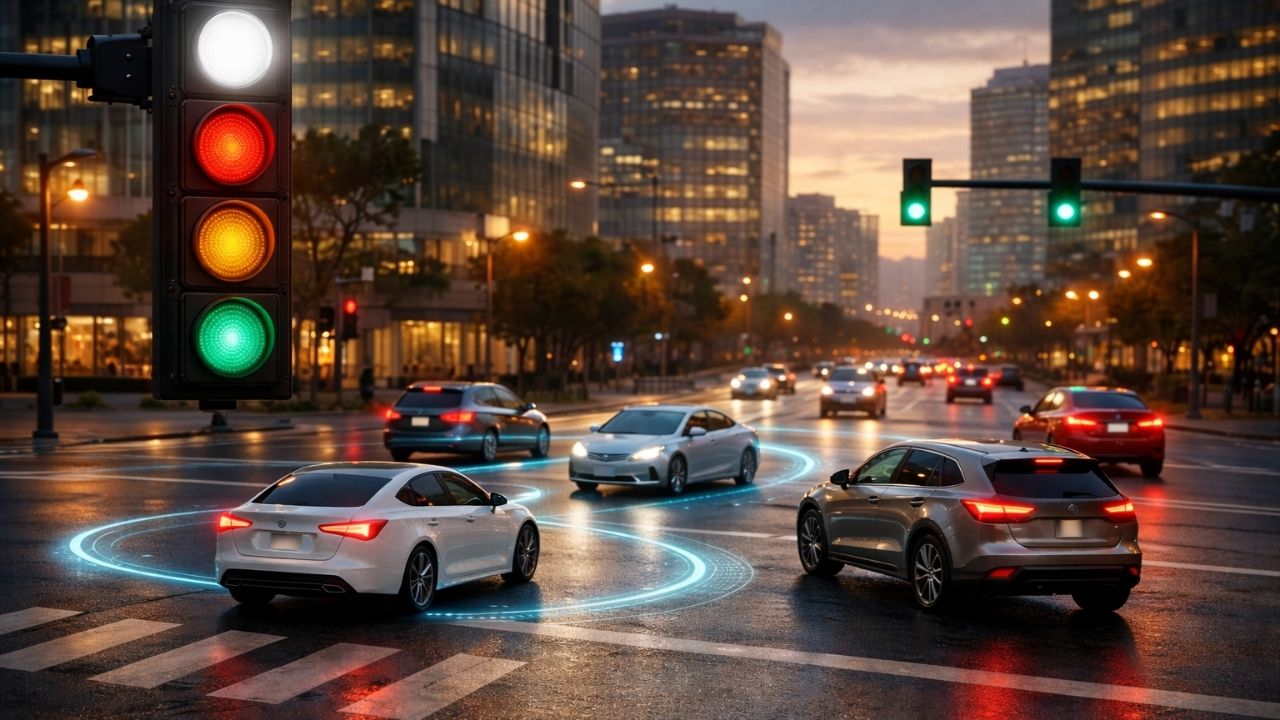
For more than a hundred years, traffic lights have relied on a simple and nearly universal language. Red instructs drivers to stop, yellow urges caution, and green allows traffic to move forward. This three-color system has shaped road safety and traffic flow worldwide, becoming so familiar that most people recognize it instinctively.
However, transportation is entering a new phase. As autonomous vehicles transition from test tracks to public roads, researchers are beginning to question whether existing systems are sufficient for the next generation of driving. In response to this shift, engineers from North Carolina State University have introduced a concept that challenges tradition while aiming to improve safety and efficiency: the white traffic light.
Table of Contents
Purpose of a White Traffic Light

The proposed white traffic light is not intended to replace the current red, yellow, and green signals. Instead, it would function as an additional indicator, activated only under specific conditions. Its role is to signal that an intersection is being largely managed by autonomous vehicles rather than human drivers.
Self-driving systems coordinate traffic at the intersection when the white light illuminates. In these moments, drivers need not interpret complex instructions or alter familiar habits. They follow the vehicle ahead, which may be an autonomous car making decisions based on real-time data.
Traditional signals remain fully operational at all times. White light appears only when autonomous vehicles are sufficiently numerous to manage traffic flow smoothly and safely. Once that condition changes, the system reverts to regular signal operation without disruption.
How Autonomous Vehicles Make This Possible

Unlike human drivers, autonomous vehicles do not rely solely on vision and reaction time. They continuously exchange information with nearby vehicles and traffic infrastructure. This includes data about speed, position, direction, and intended movements.
When several self-driving vehicles approach an intersection simultaneously, the system can quickly determine whether they can coordinate their movements more efficiently than a standard traffic signal cycle. If the conditions are right, the white light activates, allowing these vehicles to pass through the intersection in a controlled and synchronized manner.
Human-driven vehicles benefit from this coordination as well. By following the flow established by autonomous cars, overall traffic becomes smoother, with fewer abrupt stops and starts.
What Happens During a White Light Phase

A typical sequence under this system would be straightforward and temporary. As autonomous vehicles approach, they communicate with one another and with the traffic signal. If they represent a significant portion of the traffic, the white light turns on. Vehicles then move through the intersection under coordinated control. When autonomous cars are no longer dominant, the white light turns off, and standard traffic-light behavior resumes.
This adaptive approach ensures that traffic management responds to real-world conditions rather than fixed timing patterns, without forcing human drivers to learn new rules.
Why Researchers See Real Benefits
Simulation studies conducted by the research team suggest that even a small presence of autonomous vehicles can improve traffic efficiency. In scenarios in which self-driving cars accounted for only approximately 10 percent of traffic, overall delays were reduced by roughly 3 percent. These benefits become more evident as the number of autonomous vehicles increases.
Improved traffic flow brings several advantages. Reduced congestion means lower fuel consumption, fewer emissions, and less time spent waiting at intersections. From a safety perspective, smoother and more predictable movement minimizes the likelihood of collisions resulting from sudden braking or driver error.
Likely Testing Locations
Before any broader adoption, the white traffic light concept would require extensive real-world testing. Initial trials are most likely to occur in controlled environments where autonomous vehicles already operate with consistency.
Industrial zones, freight terminals, and port facilities are considered strong candidates. These areas often have high traffic volumes but fewer pedestrians and more predictable driving patterns, making them suitable for evaluating new traffic control systems under realistic yet manageable conditions.
A Glimpse into the Future of Traffic Control
The idea of a white traffic light reflects a broader reality: road infrastructure must evolve alongside vehicle technology. Autonomous cars are no longer a distant possibility, and traffic systems designed exclusively for human drivers may not be sufficient in the long term.
While the white traffic light may not appear on city streets immediately, it represents a practical step toward more effective integration of autonomous vehicles in everyday traffic. As technology continues to advance, innovations like this may gradually reshape how intersections operate, making future roads safer, more efficient, and better suited to a mixed environment of human and autonomous drivers.