
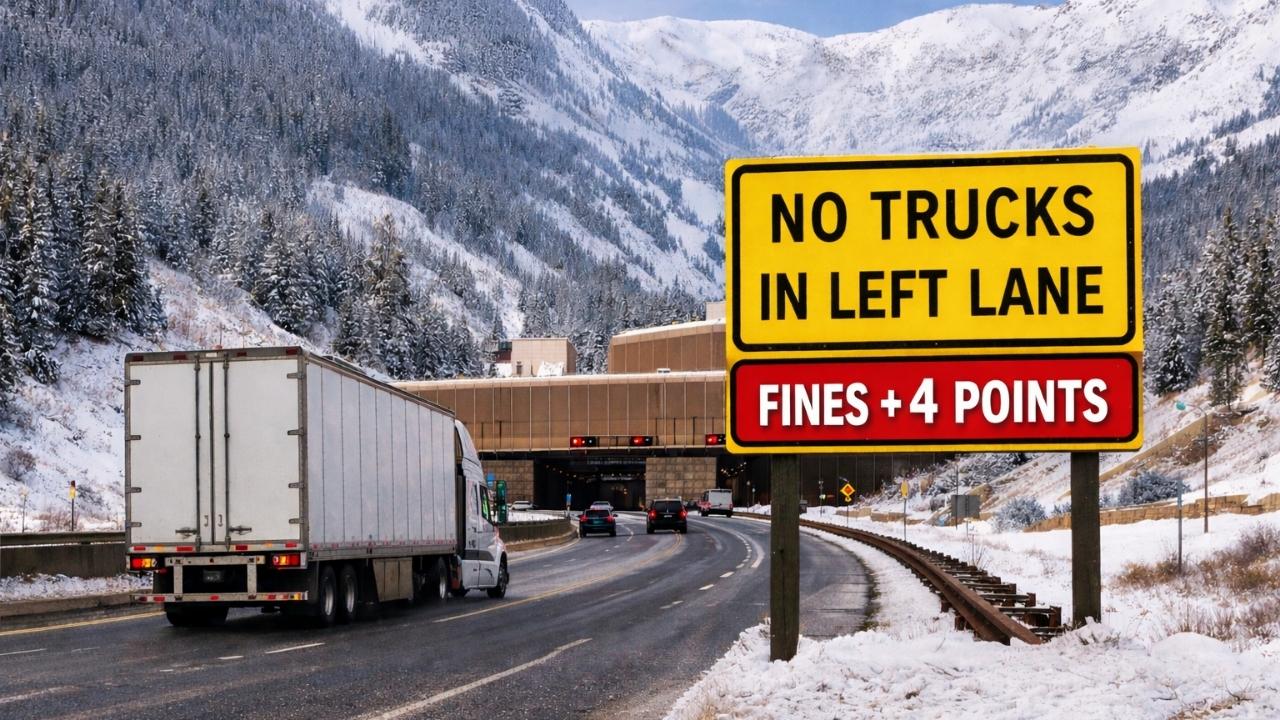
Colorado has introduced a new traffic law to reduce congestion and improve safety on some of the most challenging sections of Interstate 70. The rule restricts certain commercial vehicles from using the left lane in designated high-risk areas.
State officials say the change responds to repeated traffic shutdowns caused by slow-moving trucks on steep grades, particularly during winter storms and peak travel periods. Violations of the rule carry financial penalties and license points, with stricter consequences for commercial drivers.

The law is now being actively enforced, with new signage and lane markings appearing along affected sections of I-70.
Table of Contents
What the New Left-Lane Law Means for Drivers
The new regulation prohibits commercial motor vehicles, including semitrailers, from operating in the left lane on specific segments of Interstate 70. The restriction does not apply to passenger vehicles and is not enforced along the entire interstate.
Instead, the rule targets limited sections identified by the Colorado Department of Transportation (CDOT) as high risk. These areas are prone to congestion due to steep inclines, narrow road design, heavy freight traffic, and rapidly changing weather conditions.

According to CDOT, when large trucks occupy the left lane on uphill grades, traffic flow can deteriorate quickly. Even minor slowdowns can escalate into long delays affecting thousands of vehicles.
#CDOT #News: Safer Roads – Safer Winter: State leaders highlight new I-70 CMV left-lane restrictions and winter travel preparedness. Restrictions are in place on several high-risk stretches of I-70, helping maintain traffic flow and reduce crash risks.
📰https://t.co/UJye4Wan55 pic.twitter.com/p4mM4dUKnM
— Colorado Department of Transportation (CDOT) (@ColoradoDOT) December 3, 2025

Why CDOT Labeled Certain I-70 Sections as High Risk
CDOT based its decision on years of traffic data, incident reports, and winter maintenance challenges. Interstate 70 is a critical freight and tourism corridor, particularly through Colorado’s mountain region.
In areas such as tunnel approaches and mountain passes, a single commercial vehicle blocking the left lane can prevent traffic from moving altogether. During snowstorms, this congestion can delay plowing and de-icing, worsening road conditions and increasing crash risk.
CDOT Executive Director Shoshana Lew stated that lane closures near the Vail Pass or Eisenhower–Johnson Memorial Tunnels have previously caused travel delays of hours. The new restriction is intended to prevent those scenarios and allow maintenance crews to keep traffic moving.
Locations Where the Left-Lane Ban Applies
The restriction applies only to clearly marked sections of I-70. These locations were selected because of their history of traffic disruptions and safety concerns.
Affected areas include Vail Pass, the approaches to the Eisenhower–Johnson Memorial Tunnels, the Georgetown area, and Glenwood Canyon. Drivers will see new roadside signs and lane markings alerting them to the restriction well in advance.
CDOT has emphasized that the visual guidance is designed to reduce confusion and support consistent compliance among commercial drivers.
Fines, License Points, and CDL Consequences
Commercial drivers who violate the left-lane restriction face a $100 fine and up to four points added to their driving record. While the fine amount may appear modest, the license points carry significant weight for drivers holding a commercial driver’s license.
CDL holders are subject to stricter point thresholds than non-commercial drivers. Accumulating points too quickly can lead to license suspension, disqualification, or employment consequences, particularly for drivers who operate across state lines.
State officials note that the penalty structure reflects the seriousness of the disruption caused by left-lane blockages rather than serving as a revenue measure.
How the Law Is Being Enforced
The Colorado State Patrol is enforcing the rule through regular patrols along the restricted sections of I-70. Troopers are authorized to issue citations based on direct observation of violations.
Enforcement efforts are expected to increase during winter storms, holiday travel periods, and times of heavy congestion. Officials say strict enforcement is necessary because a predictable traffic flow is essential for both safety and road maintenance in mountain terrain.
Drivers who ignore posted restrictions in hazardous conditions are more likely to be cited, especially when their actions contribute to delays or unsafe driving.
Connection to Winter Road Maintenance and Safety
The left-lane restriction plays a key role in Colorado’s winter operations strategy. Snowplows and de-icing trucks rely on consistent traffic patterns to operate efficiently on steep, narrow roadways.
When traffic becomes unpredictable due to preventable lane blockages, snow and ice can accumulate faster, reducing traction and visibility for all motorists. CDOT says keeping commercial vehicles in designated lanes allows crews to maintain road quality more effectively.
Commercial drivers who comply with the rule may also benefit from staying in lanes that receive more frequent plowing and treatment, reducing their own risk of skidding or loss of control.
Part of a Broader Trend in Driver Safety Laws
Colorado’s new rule reflects a broader national trend toward targeted traffic regulations to improve safety and reduce disruptions. Several states are implementing stricter driver laws in 2025, including changes related to impaired driving, traffic stops, and roadside safety.
Transportation agencies across the US are increasingly using data to identify high-risk behaviors and locations and then applying targeted restrictions rather than broad statewide bans.
Frequently Asked Questions
Who does the left-lane restriction apply to?
The restriction applies to commercial motor vehicles, including semitrailers and other large trucks. Passenger vehicles are not affected by the rule.
Does the ban apply to all of Interstate 70?
No. The restriction applies only to specific, clearly marked sections of I-70 that CDOT has designated as high risk.
What happens if a commercial driver violates the rule?
A violation can result in a $100 fine and up to four license points. For CDL holders, these points can lead to faster disciplinary action.
Who is enforcing the new law?
The Colorado State Patrol is responsible for enforcement and conducts regular patrols, especially during storms and peak travel periods.
Why is the law focused on winter conditions?
Winter weather amplifies the impact of traffic slowdowns on mountain highways. Predictable traffic flow is essential for snow removal, de-icing, and overall road safety during severe conditions.