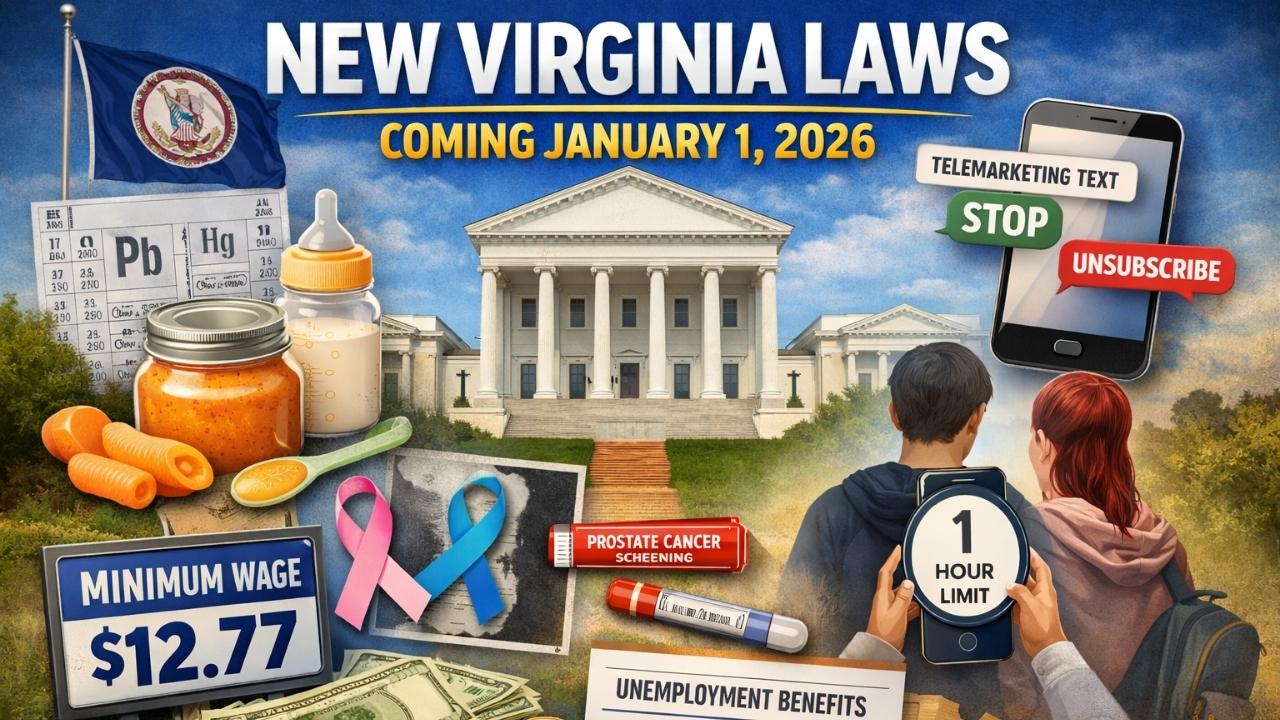
Several new Virginia laws are scheduled to take effect on January 1, 2026, bringing changes to consumer protections, healthcare coverage, employment standards, digital safety for minors, and agricultural oversight. The measures were approved during recent General Assembly sessions and are set to apply statewide at the start of the new year.
The updates include a higher minimum wage, increased unemployment benefits, mandatory insurance coverage for certain cancer screenings, stricter baby food safety rules, and new limits on social media use for minors. Together, these laws introduce regulatory changes that will impact households, businesses, healthcare providers, and digital platforms across the Commonwealth.
Table of Contents
New Safety Requirements for Baby Food and Infant Formula

Virginia will implement stricter oversight of baby food and infant formula under the Baby Food Protection Act (HB 1844). The law requires manufacturers to regularly test their products for toxic heavy metals, including substances that can pose developmental risks to infants and young children.
Manufacturers must ensure that metal levels remain within limits established by the U.S. Food and Drug Administration. Testing is not a one-time requirement and must be conducted on an ongoing basis to ensure continued compliance.
The law also expands transparency obligations. Companies must disclose testing results on product packaging and publish the same information on their websites. In addition, consumers who suspect unsafe metal levels in baby food products must report their concerns to the Virginia Department of Agriculture and Consumer Services, enabling regulators to review and investigate potential risks.
Stronger Protections Against Unwanted Telemarketing Messages

Changes to the Virginia Telephone Privacy Protection Act, enacted through SB 1339, will give residents greater control over unsolicited telemarketing texts and notifications.
Beginning in 2026, consumers will be able to stop unwanted messages by replying with commands such as “STOP” or “UNSUBSCRIBE.” Once an opt-out request is received, telephone solicitors must immediately stop sending messages.
A key provision of the law requires telemarketers to honor opt-out requests for at least ten years. This extended enforcement period is designed to reduce repeated violations and limit companies’ ability to resume messaging after short intervals. Telemarketers will be responsible for maintaining records to ensure long-term compliance.
Social Media Time Limits for Users Under 16

Virginia is updating its digital consumer protection rules to address concerns related to youth social media use. Amendments to the Consumer Data Protection Act under SB 854 will introduce default daily usage limits for minors.
Social media platforms must use neutral age-screening mechanisms to identify users under 16. Once identified, those users will be limited to one hour of daily usage per platform unless parental consent is provided.
Parents or legal guardians can adjust time limits based on family preferences. Platforms must offer tools that allow parents to manage permissions and monitor usage. The law places responsibility on platforms to enforce time limits while preserving parental authority over changes.
Clearer Disclosure of Court Fines and Fees
A new procedural requirement under HB 1665 will improve transparency for individuals required to pay fines or fees following a criminal conviction or violation.
Defendants may request a detailed breakdown of all fines, costs, and fees associated with their case. Requests may be submitted in writing or electronically to the court clerk.
The law also allows individuals to request updated statements over time, making it easier to track payments, remaining balances, and any adjustments. The change is intended to reduce confusion and improve access to accurate financial information related to court obligations.
Expanded Insurance Coverage for Cancer Screenings
Several insurance-related laws will take effect in 2026, expanding coverage for preventive cancer screenings and eliminating patient cost-sharing.
Under HB 1828/SB 1436, health insurance providers regulated by Virginia must fully cover breast cancer screening procedures, including mammograms, MRIs, and ultrasounds, when ordered by a healthcare provider. Patients will not be required to pay deductibles, copayments, or coinsurance for these services.
In addition, HB 2097/SB 1314 requires insurance carriers to cover prostate cancer screenings, such as blood tests and rectal exams. Coverage must align with current American Cancer Society guidelines and reflect evolving medical recommendations.
Wage and Unemployment Benefit Increases
Virginia workers will see changes to both wages and unemployment benefits beginning January 1, 2026.
The state minimum wage will increase from $12.41 per hour to $12.77 per hour, according to the Virginia Department of Labor and Industry. The adjustment follows a previously approved wage schedule and applies statewide.
Unemployment benefits will also rise under HB 2401/SB 1056. Eligible individuals who lose their jobs will receive an additional $52 per week in unemployment compensation. The increase is intended to provide added financial support during periods of job transition.
What Residents and Businesses Should Expect
The new laws introduce compliance obligations for manufacturers, insurers, employers, telemarketers, and digital platforms. Businesses will need to update internal policies, systems, and disclosures to meet the new standards, while residents may see changes in wages, medical costs, and consumer protections.
Although some effects will be immediately noticeable, such as higher pay rates or expanded insurance coverage, others will operate through enforcement and regulatory oversight as the laws are implemented across the state.